Filtration membranes
Taking the Guesswork Out of a Membrane Pressure Test
An automated bubble point test that raises air pressure on a membrane sample along a programmed profile, so every sample is tested the same way, replacing a hand-turned regulator.
The problem
A membrane manufacturer checks the tightness of its membranes with a bubble point test. A sample sits in a holder under water, air pressure is slowly raised on one side, and the pressure at which the first bubble appears on the other side is the result.
The pressure was raised by hand with a manual regulator. Because the speed of the rise affects the result, two operators, or the same operator on two different days, could get different numbers from the same membrane.
What we built
The right hardware. We specified an electronically controlled pressure valve with its own built-in regulation and a pressure readback, and compared two compact data acquisition setups for the client, recommending the one with room to add more later for little extra cost.
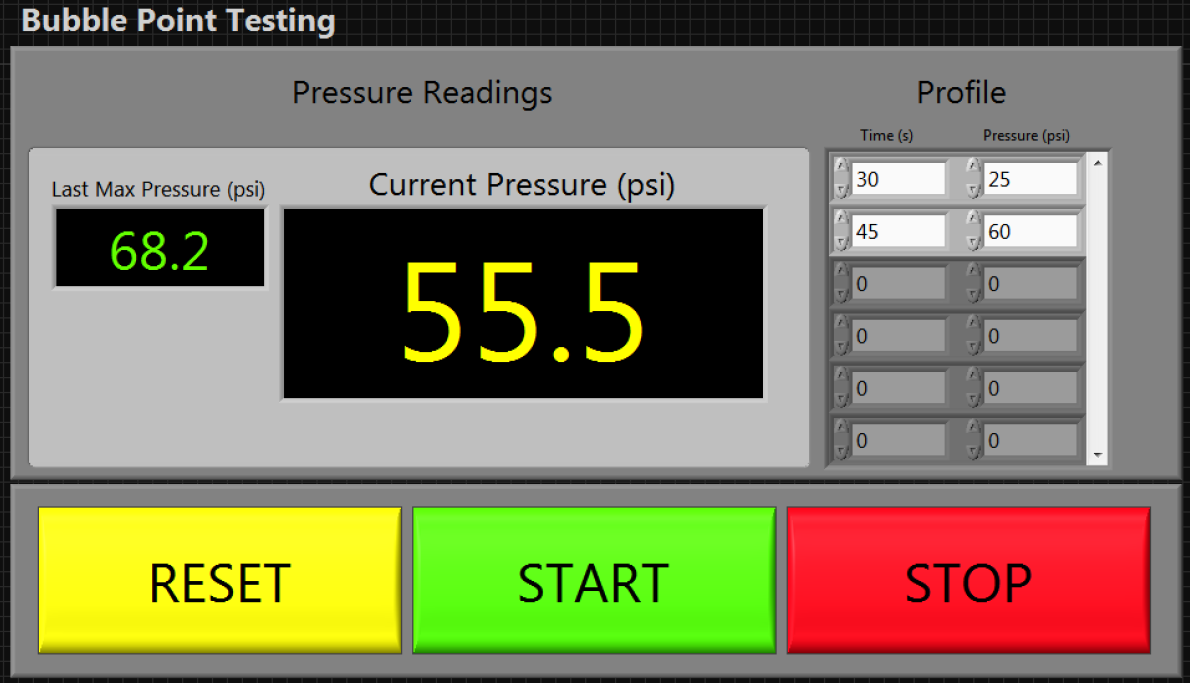
Programmable pressure profiles. The operator, or an administrator through a configuration file, defines the test as a series of steps. For example: rise to 25 psi over 30 seconds, then to 60 psi over the next 45, then hold. Every sample now sees exactly the same rise.
A screen built for the test bench. Current pressure is shown in large digits that can be read from across the bench, next to the peak pressure from the previous test. Start, stop, and reset are large buttons with keyboard shortcuts, so the operator can keep their eyes on the membrane and stop the test the moment a bubble appears.
Easy to install. We delivered the application as an installer, so the client could set it up on their own laptop.
Earlier work for the same client
This was the second project for this client. The first replaced a slow routine for running a stepper motor (edit a file, upload it to the controller, then run) with a simple screen for changing the motor’s speed live. It checks for the motion controller at startup and shows a clear connection light before enabling the controls.
The result
The bubble point became a repeatable measurement instead of one that depended on the operator’s hand, and the test bench got a screen that keeps the operator’s attention on the sample.
- LabVIEW
- NI CompactDAQ
- Proportional pressure control
- Hardware selection
- Installer deployment